-
Teruko Yokoi: The Emergence of the Diamond
Works on Paper, 1956-1960 -
In October 1960, the Institute of Contemporary Arts in London opened The Mysterious Sign, a group exhibition curated by the critic and poet Robert Melville. A central voice in postwar British art discourse, Melville approached painting as a form of visual language, bringing together artists across art movements whose work explored meaning through symbol and mark.
The exhibition assembled an international group of artists spanning Europe and the United States, including figures such as Pablo Picasso, Wassily Kandinsky, Paul Klee, Franz Kline, and Jackson Pollock. Drawn from major institutional and private lenders, including The Museum of Modern Art, the Solomon R. Guggenheim Museum, and the Stedelijk Museum, the exhibition placed emerging and lesser-known voices in direct dialogue with some of the most established artists of the twentieth century.
As outlined in the ICA’s archival materials gathered from the Tate Archives and the Yale Center for British Art, the exhibition explored painting as a kind of writing on a flat surface. Signs, symbols, and gestures function not as illustrations, but as carriers of meaning that resist direct translation. The works ranged from calligraphic and pictographic forms to more abstract systems of notation, suggesting connections between painting and broader languages of communication, from manuscript to code. Notably, many of the works included were intimate in scale, challenging the prevailing assumption that the power of contemporary painting depended on size or spectacle.
Within this context, meaning is implied rather than declared. It emerges through repetition and variation across the surface. Painting becomes less an image to be read and more a field to be experienced.
It is within this framework that Teruko Yokoi’s work must be understood. As one of the few women included in The Mysterious Sign, her work entered into direct dialogue with these major figures, contributing to a shared language of abstraction that was still being defined in real time.
The Emergence of the Diamond continues Emerald Room’s ongoing program of research-led presentations examining the formative years of Teruko Yokoi’s practice. Building on earlier studies and informed by recent archival and on-the-ground research, this presentation reflects a curatorial thesis now coming into sharper focus, laying the groundwork for a broader sequence of exhibitions and institutional dialogue in the years ahead.
-
The Diamond as a Sign
Paris Studio, c. 1960
-
-
Scale and Compression
-
Archival Material: The Mysterious Sign, ICA London, 1960
Archival material from The Mysterious Sign (Institute of Contemporary Arts, London, 1960), curated by Robert Melville, provides further context for the exhibition and its scope. These pages document an international field of artists and confirm Teruko Yokoi's inclusion within a significant group working at the forefront of postwar abstraction.
-
The Diamond in Practice
By the late 1950s, Yokoi's practice had reached a point of sustained focus and discipline. Studio photographs from her Chelsea Hotel workspace present an artist fully engaged in the demands of her work, surrounded by paintings that move fluidly between scale and medium. The atmosphere is deliberate rather than provisional.
During this period, the diamond form had already become a recurring and structuring element within her compositions. It appears not as a singular motif, but as a form under continuous examination, shifting in proportion, orientation, and density across works. The orderly symmetry of her earlier diamonds gives way to more asymmetrical configurations, often nested or composed of layered elements that produce more organic or distorted forms. This sustained attention suggests a method grounded in repetition and refinement rather than experimentation alone.
Within the context of her broader cultural framework, the diamond carries associations that extend beyond formal geometry. Its angular clarity and enclosed structure resonate with ideas of containment, protection, and interior space, aligning with visual traditions in which form operates as both image and sign.
What emerges in these works is a practice defined by concentration and continuity. Yokoi is not responding to external influence. Instead, she is developing a language through persistent inquiry, establishing a foundation that would carry forward into her later work across Europe. This clarity of structure would soon be tested under new conditions, as her practice shifted across geographies and intensified in both scale and urgency. This will become the subject of future examination. Here, the diamond begins to take on a more central role, functioning as a vessel through which these pressures are held in balance.
-
Presence in the Studio
-
New York and Paris: A Transnational Practice
Following her studies with Hans Hofmann, Yokoi established herself within the New York art scene before extending her practice to Paris, where she maintained a studio and deepened her engagement with European abstraction. The transition was not simply geographic. It marked a shift in the conditions under which her work was made.
In New York, the studio became both a site of production and a space of refuge. Having completed her studies, Yokoi’s immigration status grew increasingly uncertain, shaping the terms of her daily life. Much of her experience was contained within the interior, at times observing the city from her rear window rather than moving freely through it. Early works from this period reflect a heightened sensitivity to enclosure and boundary, where geometric forms begin to register not only as compositional elements, but as structures of containment.
Studio photographs from this period document a sustained investigation of form across multiple works in progress. In both New York and Paris, the studio functions as a site of continuity and inquiry, where ideas are revisited, adjusted, and carried forward rather than resolved in isolation. As her circumstances shifted, so too did her working methods. Smaller formats, portable materials, and works on paper allowed her to maintain a consistent practice within conditions that were increasingly transient.
Paris introduced a different set of constraints. Working within a more limited domestic space while raising her young daughter, Yokoi adapted her process without relinquishing its intensity. Forms that had once held a more rigid geometry begin to loosen, becoming more fluid, layered, and responsive. The diamond, already present in her earlier work, continues to evolve within this context, no longer fixed, but adjusting in scale, density, and relation to surrounding space.
Across these environments, the diamond operates as a structuring device that holds the composition while remaining open to variation. Its repetition is not static, but responsive, absorbing the pressures of movement, displacement, and continuity.
What emerges is a practice shaped by distance as much as proximity. While Yokoi maintained active relationships with galleries such as Martha Jackson in New York, the physical and administrative constraints of her situation limited her ability to fully inhabit that space. The connection remained active, but not fully accessible.
Within this context, her work reflects a broader condition of postwar painting, in which artists moved between overlapping cultural centers while constructing distinct and personal systems of form. Yokoi’s contribution emerges not from visibility alone, but from persistence, clarity, and a sustained commitment to the work itself.
-
Paris Studio: Work and Continuity
-
Position and Independence
Yokoi’s work developed within a milieu largely defined by male artists, yet it resists being framed in relation to them. While she maintained meaningful relationships with figures such as Joan Mitchell and Mark Rothko, her practice is guided by an internal logic that does not depend on proximity or comparison.
Her paintings do not rely on scale, gesture, or spectacle to assert their presence. Instead, they build meaning through structure and repetition. Forms are tested, adjusted, and rearticulated across works, establishing a visual language that evolves through sustained inquiry.
This approach reflects a commitment to autonomy. Rather than responding outwardly to prevailing movements, Yokoi constructs a space of inquiry within the surface itself, where form, color, and edge are held in careful balance.
In this context, the diamond emerges not as a stylistic device, but as part of a broader system of thinking. It operates within a structure that allows the work to remain both grounded and open, precise yet generative.
Independence determines Yokoi’s position, not opposition. Her work occupies its own territory within postwar abstraction, defined by clarity of intention and a sustained rigor that unfolds over time.
-
A Field of Works: New York and Paris, 1956-1960
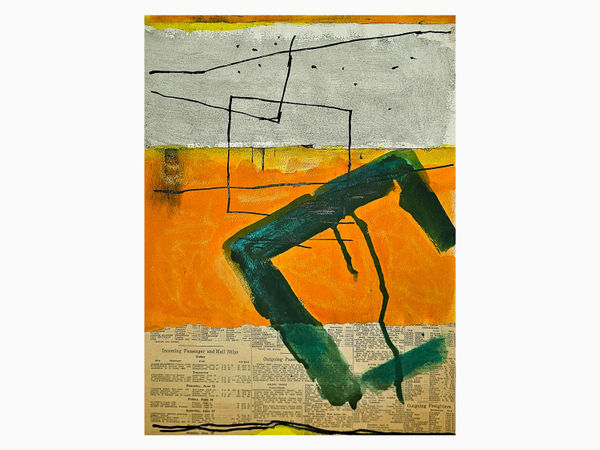
The works presented here emerge from a concentrated period between Paris and New York, where Yokoi developed a distinctly personal visual language shaped through calligraphic mark-making, anchoring geometric forms, and fluid fields of color.
Working primarily in small to medium formats on paper, cardboard, and collage, these works reflect both the material conditions and the pace of her production. Within these more intimate formats, Yokoi tests compositional ideas with precision and intensity.
While modest in scale, the works operate within a consistent internal logic. Structural forms, often angular or diamond-like, are introduced, disrupted, and reconfigured across compositions. Color shifts between restraint and saturation, and surfaces are built through layering and revision rather than singular gesture.
Several works relate to documented exhibition activity from the period, while others are known through archival photography and correspondence. Together, they reflect a moment of rapid development, where Yokoi’s practice moves between containment and release to establish the foundation of her mature language.
-
-
Martha Jackson Gallery and Transatlantic Visibility
Archival material from the Martha Jackson Gallery, courtesy of the University at Buffalo Art Galleries, custodians of the Martha Jackson and David Anderson archives, provides important context for Yokoi’s early presence within the New York art scene and her expanding international visibility during this period.
Registrar records and consignment documentation confirm the movement of works between Yokoi and the gallery, reflecting an active commercial and exhibition relationship. These materials indicate sustained engagement with the New York market, even as Yokoi was living and working in Paris.
While the documentation remains partial, it suggests a pattern of circulation between Paris, New York, and London, aligning with the broader timeline of exhibitions such as The Mysterious Sign at the Institute of Contemporary Arts. Within this context, Yokoi’s work participates in a transnational dialogue, positioned alongside key figures of postwar abstraction while maintaining a distinct and independent trajectory.
These records do not function as definitive exhibition lists, but as evidence of presence and recognition at a formative moment in her career.
-
The archival material presented here reflects a period shaped not only by artistic development, but by broader political and personal conditions. Yokoi’s movement from New York to Paris, and ultimately to Switzerland, occurred at a moment when U.S. immigration policy placed real limits on her ability to remain.
Despite these constraints, her work continued to circulate internationally. Through galleries such as Martha Jackson in New York and Minami in Tokyo, and through exhibitions in London and across Europe, Yokoi maintained an active presence across multiple contexts.
The letters and records surrounding works such as Mauve Diamond, Green and Gray and Blackout point to a practice that remained globally engaged, even as the conditions of her life required constant adaptation. It is within this tension between movement and restriction that the work of this period takes on its urgency.
-
-
A Structure Held in Tension
Across the works presented here, the diamond emerges not as a fixed motif, but as a structure tested across conditions. It shifts in scale, density, and material, responding to changes in environment while maintaining a consistent internal logic.
What becomes clear is a practice defined by continuity rather than rupture. Forms are revisited, adjusted, and extended across works, allowing meaning to accumulate through repetition and variation. The diamond does not resolve these tensions, but holds them.
Seen together, these works reflect a moment in which Yokoi’s language is both established and in motion. The conditions of her life, movement between cities, shifts in scale, and constraints of space, are not separate from the work, but embedded within it.
-
The Emergence of Form
The Emergence of the Diamond continues Emerald Room’s ongoing program of research-led presentations examining the formative years of Teruko Yokoi’s practice. Building on earlier studies and informed by recent archival and on-the-ground research, this presentation reflects a curatorial thesis now coming into sharper focus, laying the groundwork for a broader sequence of exhibitions and institutional dialogue in the years ahead.
The works gathered here mark a period in which Yokoi established a visual language grounded in structure, repetition, and sustained inquiry. Developed across New York and Paris, and supported through relationships with galleries such as Martha Jackson and Minami, this body of work situates her within an international network while maintaining a distinct and independent trajectory.
At the same time, these works reflect the conditions under which they were made. Movement between cities, limitations on mobility, and the demands of daily life shaped both the scale and material of her practice. Within these constraints, Yokoi developed a language that remained consistent, adaptable, and precise.
What emerges is not a peripheral position, but a sustained contribution to the development of postwar abstraction. The works presented here offer a focused view into that moment, establishing a foundation for future exhibitions that will extend this inquiry across larger formats, later periods, and broader institutional contexts.
-
References and Archival Sources
This presentation draws on primary archival materials, exhibition records, and correspondence from institutional and estate sources, including:
- University at Buffalo Art Galleries, custodians of the Martha Jackson and David Anderson archives
- Tate Archives, London
- Yale Center for British Art
- Estate of Teruko Yokoi
Additional research includes exhibition records, correspondence, and photographic documentation from the period 1956-1964.
TERUKO YOKOI: The Emergence of the Diamond: Works on Paper, 1956-1960
Past viewing_room